
Understanding US Home Equity Lending and Tokenized Private Credit
Understand US home equity lending, where private credit returns come from and how tokenization connects businesses to strategies like PRIME through Reah Treasury.

Home equity lending and business treasury rarely appear in the same conversation. One involves homeowners borrowing against the value of their property, while the other involves companies deciding how to hold and allocate their reserves.
But the lending activity behind home equity credit can also create an opportunity for capital providers. And tokenization is opening up new ways to access that exposure.
That connection is behind the PRIME USDC vault, recently added to Reah Treasury in collaboration with Hastra, Figure, Ground and Tempo. This vault allows global businesses on Reah to gain tokenized exposure to US home equity lending directly from their business treasury reserves, alongside other treasury strategies.
To understand the opportunity, it helps to look first at the lending market itself: how home equity loans work, what drives returns, and which characteristics distinguish this credit from other treasury assets. From there, we'll look at what tokenization changes and how Hastra, Figure, Ground, Tempo and Reah each fit into the structure.
What is US home equity lending?
Home equity is the difference between the value of a home and the debt secured against it. A home valued at $500,000 with an outstanding $250,000 mortgage has approximately $250,000 of equity. That isn't necessarily the amount its owner can borrow: lenders apply underwriting criteria and limits based on property value, existing debt and the borrower's ability to repay.
A home equity line of credit, commonly called a HELOC, lets an eligible homeowner borrow against part of that equity. HELOCs are typically revolving credit arrangements: borrowers can draw up to an approved limit, repay amounts owed and, subject to their agreement, draw again. Interest is generally charged on the outstanding balance.
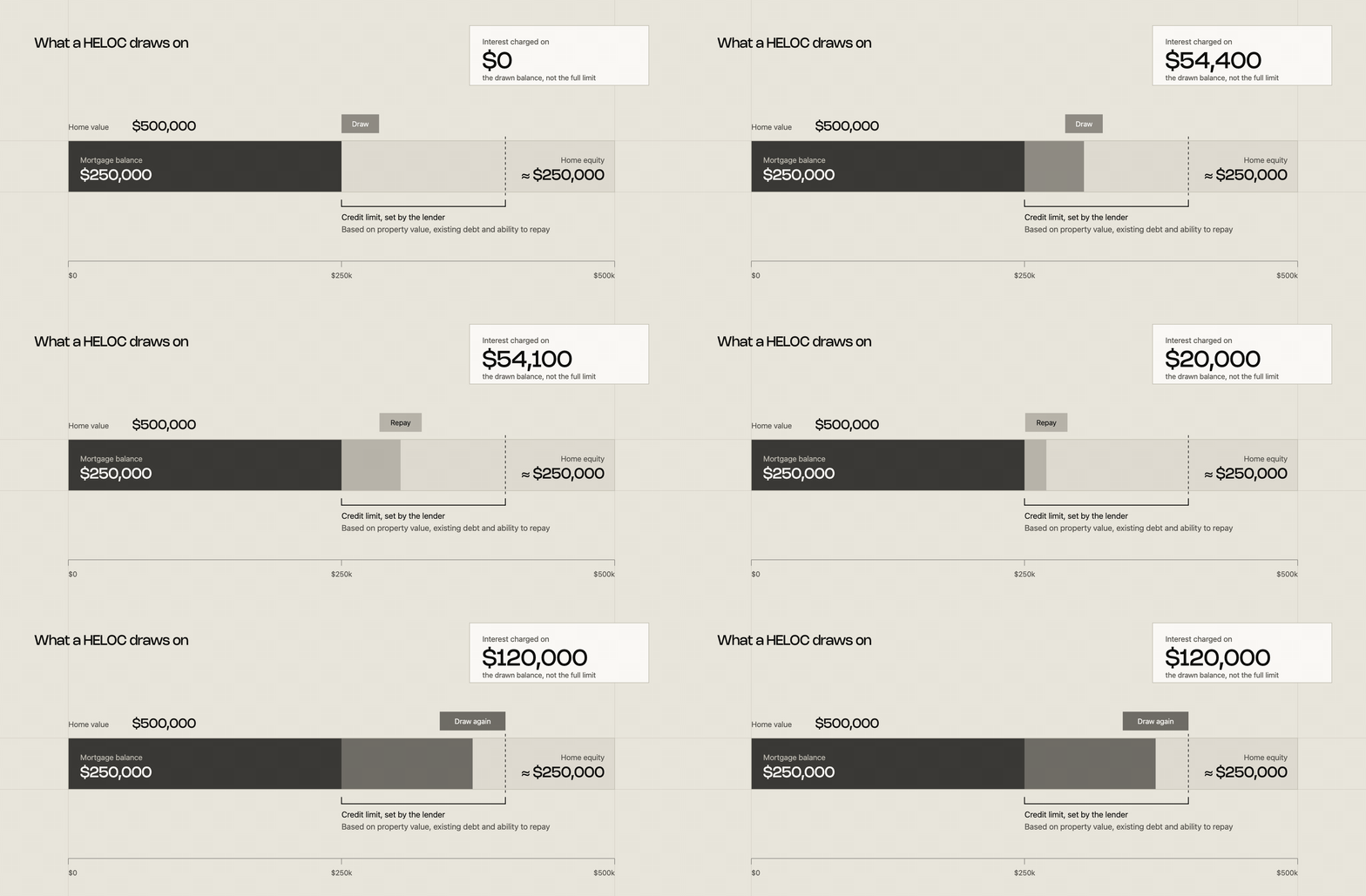
For borrowers, the proceeds might fund renovations, education, debt consolidation or other expenses. For lenders and financing providers, those loans create an asset backed by residential property and supported by the borrower's contractual interest and principal payments.
Unlike owning property directly, gaining exposure to home equity lending means participating in a credit strategy. Its economics depend on loan terms, interest rates, borrower performance, financing structure and the value of the underlying collateral.
Why are businesses interested in home equity lending?
Businesses evaluating treasury strategies typically consider more than the headline yield. The underlying source of return, the possibility of loss and how quickly funds may be needed all matter.
Home equity lending offers exposure to a different part of the credit market from short-term government securities and money-market strategies. US Treasury bills generate returns through government borrowing. Home equity lending generates returns through private borrowers paying interest on loans secured by residential property.
This distinction can make private credit relevant to a broader mix of reserve allocations. Returns may respond to different market forces, including consumer credit conditions, loan demand, interest rates, underwriting quality and housing-market performance.
But different doesn't mean automatically better. A collateral-backed loan can still default, collateral values can fall, recoveries may take time, and participation in the financing market may entail liquidity constraints. For business treasury teams, comparing these strategies requires understanding their underlying exposure, not just comparing annual percentage yields.
How does home equity lending generate returns?
The process starts when a lender extends a credit line and a homeowner draws on it. The borrower owes interest on the outstanding loan balance. The lending institution originates and services the loan, but financing those loans can involve other capital providers.
In a lending marketplace, capital providers may finance eligible loans or lending pools under defined arrangements. The resulting returns reflect the economics of the financing structure, including interest income, utilization, fees, credit performance and other costs.
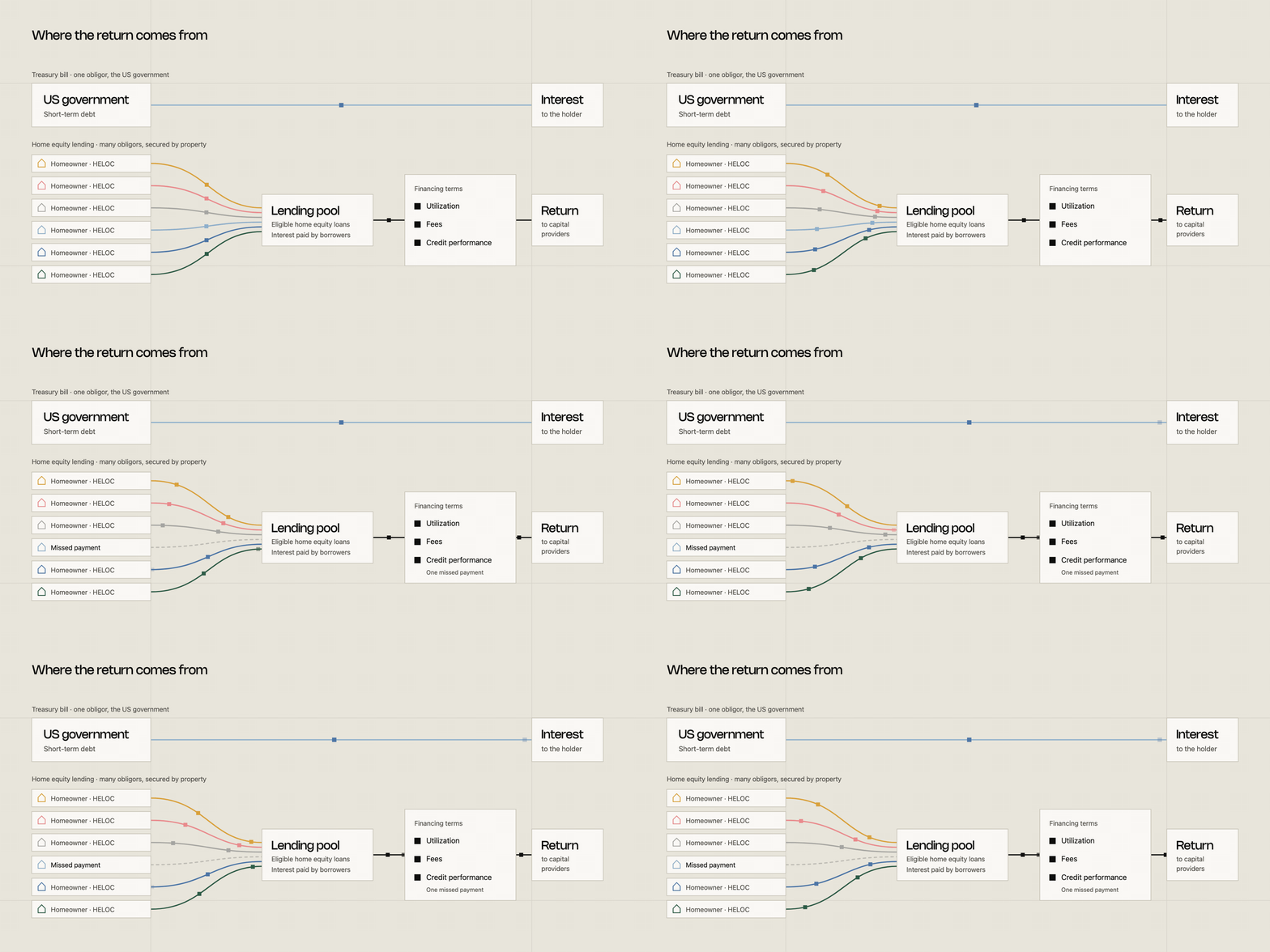
This matters because exposure to a lending pool is not the same as buying an individual mortgage or collecting interest directly from a homeowner. Investors or treasury strategies participate through financial products with their own terms and rights.
Figure's Prime lending marketplace connects capital with financing activity tied to underlying home equity loans. It provides the real-world lending exposure on which the PRIME strategy is built.
What is tokenized private credit?
Tokenized private credit uses blockchain-based tokens to represent interests or economic exposure associated with private loans and financing structures.
The underlying borrowers, loan agreements and repayment obligations do not disappear. Tokenization changes how an eligible financial product can be represented, transferred, distributed or integrated with other financial systems.
Depending on the structure, a tokenized credit product can be accessed through a compatible treasury platform using stablecoins, with onchain transaction records and programmable settlement infrastructure. The holder's legal rights and potential returns, however, depend on the particular product and its underlying arrangements.
That distinction is important. Tokenization does not turn a private loan into a bank deposit, eliminate credit risk or guarantee immediate access to cash. It can improve the infrastructure around exposure to a financial asset without changing the asset's fundamental economics.
What are the benefits of tokenizing private credit?
Broader distribution of financial products. Tokenized products can reach eligible businesses through more digital financial platforms, rather than requiring a separate relationship with every underlying financing provider. Eligibility and jurisdictional restrictions still apply.
Integration with existing treasury operations. Supported stablecoins can provide a familiar funding route for a treasury allocation. Businesses can manage that allocation through their existing product permissions and reporting instead of assembling yet another operational process.
Faster settlement of onchain transactions. Blockchain-based transfers can settle quickly, simplifying some movement and reconciliation steps. A fast token transfer should not be confused with guaranteed immediate redemption of the underlying private-credit position.
Programmable workflows and greater transaction visibility. Onchain infrastructure can support transparent transfer records and integrations with business-level approval policies, monitoring and controls. The underlying loan records and legal documentation may still be maintained outside the blockchain.
New ways to package and distribute strategies. Tokens and managed vaults can connect specialized lending markets with platforms serving global businesses. The benefit lies in making those arrangements easier to use, not in removing the need to understand how they work.
For finance teams, the practical question is whether tokenization improves access and operations while preserving clear information about the asset, its terms and its liquidity profile.
How does Figure PRIME provide exposure to US home equity lending?
Figure's Prime marketplace is the connection to the underlying lending. Its ecosystem originates and services eligible home equity loans and provides infrastructure through which financing capital can participate in that lending market.
Hastra's PRIME product brings tokenized exposure to that credit activity. The product is linked primarily to home equity lines of credit, alongside other eligible assets or liquidity holdings under its governing terms. The return is variable, driven by lending-market economics and the particular product structure.
The relationship between Figure's YLDS security, Hastra's wrapped YLDS representation (wYLDS) and PRIME warrants precision. YLDS is described in product documentation as an SEC-registered interest-bearing security; that status should not be transferred by implication to Hastra's separate PRIME token or to the Reah vault. Each instrument has its own legal and operational role.
The essential distinction for a treasury customer is straightforward: the strategy's exposure comes from real-world lending; tokenization provides a means of packaging and accessing that exposure. Customers are not purchasing individual homeowners' properties or selecting individual loans through Reah.
How do Ground and Tempo support tokenized lending strategies?
Access to a tokenized asset still requires the infrastructure to accept deposits, manage the vault position and handle redemptions.
Ground deploys and manages the PRIME USDC vault available through Reah Treasury. Its infrastructure connects the underlying tokenized strategy with the vault product offered to businesses, while managing operational mechanics that a treasury platform would otherwise need to integrate separately.
Tempo provides the blockchain network where the vault is deployed and supported stablecoin transactions settle. Its design for stablecoin-based financial activity supports fast network finality and stablecoin-denominated fees.
There are two distinct kinds of timing to consider. One is the settlement of an onchain transfer. The other is the time required to redeem the underlying credit strategy and receive usable funds. Instant network settlement does not, by itself, guarantee an instant exit from private credit.
[Partner verification required: Ground and Tempo to explain any specific instant-exit feature for this vault, the liquidity source, redemption path and conditions under which immediate exits may be unavailable. Do not claim unconditional instant liquidity.]
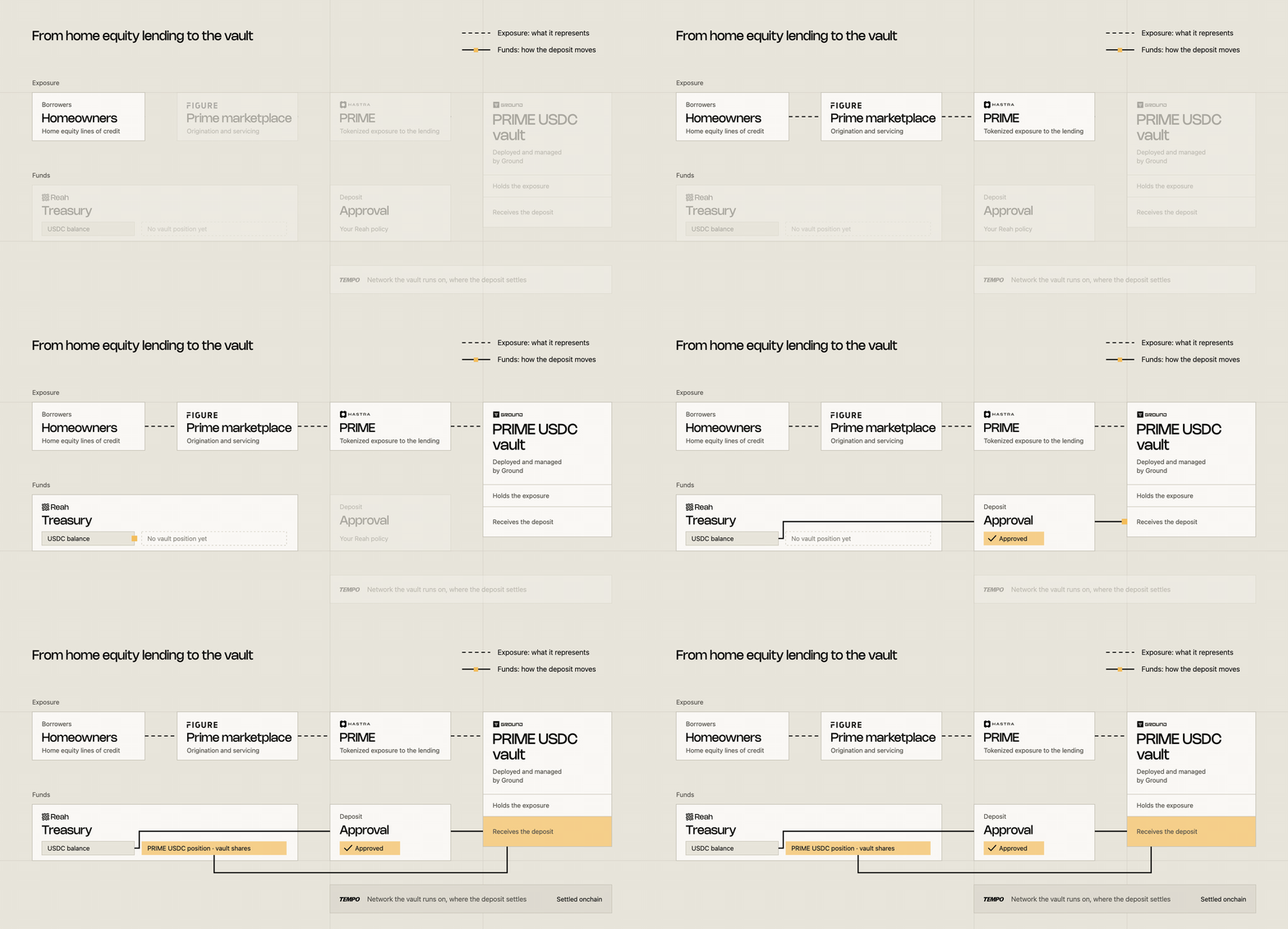
From home equity lending to the PRIME USDC vault
The different parts of the structure serve distinct purposes:
Participant | Role |
|---|---|
Figure | Underlying home equity lending marketplace and associated origination and servicing ecosystem |
Hastra | PRIME tokenized strategy and its related product structure |
Ground | Deployment and management of the PRIME USDC vault |
Tempo | Blockchain infrastructure for the vault and onchain settlement |
Reah | Treasury interface, eligible customer access and account-level financial controls |
The credit exposure, tokenized product, vault and customer experience are related, but they aren't interchangeable. In particular, the economic path from borrowers to the credit strategy is different from the operational path of a business depositing stablecoins into the vault.
Creative brief: Produce a two-lane explanatory diagram rather than a simplistic six-company arrow chain. Lane one traces the underlying lending and tokenized exposure; lane two follows the business's deposit into the Ground-managed vault on Tempo and visibility inside Reah Treasury. Label the movement of funds separately from the representation of exposure.
How can businesses access tokenized private credit through Reah Treasury?
Eligible Reah customers can explore the PRIME USDC vault from the Treasury section of the platform and follow the supported stablecoin deposit flow. The vault position appears alongside other available treasury strategies, with Reah's existing approvals and transaction visibility.
This is the practical benefit of bringing specialized financial products into business treasury: customers don't have to manage their bank balances, stablecoin wallets, payments and available treasury positions through disconnected providers.
PRIME expands the types of tokenized real-world asset exposure available through Reah. Treasury already includes strategies linked to government securities, money-market products and other credit markets. Adding US home equity lending provides another underlying source of potential return, with a distinct risk and liquidity profile.
For reserves needed to meet near-term expenses, liquidity and capital preservation remain central considerations. Private-credit exposure should be evaluated against the business's time horizon and its operating cash requirements.
Learn more about the PRIME strategy on Hastra and explore available treasury strategies at Reah.
Frequently asked questions
How does home equity lending differ from a US Treasury bill?
A Treasury bill is short-term US government debt. Home equity lending is private credit issued to households and secured by residential property. The two have different obligors, sources of return, risk characteristics and potential liquidity.
Where does yield from tokenized home equity lending come from?
The underlying economic source is the lending activity and the terms of its financing arrangements, including interest paid by borrowers. Tokenization does not create interest income on its own. Returns depend on utilization, financing terms, credit performance and fees.
What is the difference between Figure Prime and Hastra PRIME?
Figure's Prime marketplace concerns the underlying financing market for eligible loans. Hastra's PRIME is a tokenized strategy providing exposure linked to that market. The products play different roles and should not be treated as interchangeable.
Does tokenization remove the risks of private credit?
No. The underlying credit is still exposed to borrower defaults, financing conditions and collateral performance. Tokenized delivery can add smart-contract, operational and infrastructure considerations. The specific risk profile depends on the product.
Can I redeem the PRIME USDC vault instantly?
Onchain settlement speed and redemption liquidity are separate questions. The actual time to exit depends on the Ground-managed vault's terms and available liquidity. Review the product's current redemption conditions; don't assume that fast settlement guarantees immediate cash availability.
Who can access the PRIME USDC vault on Reah?
Businesses with a Reah account can access the PRIME USDC vault alongside banking, wallets, corporate cards and Reah Agent. Eligible customers can find the strategy and its current terms within Reah Treasury.
Can businesses access other tokenized real-world assets through Reah?
Yes. Reah Treasury offers a selection of tokenized strategies with exposure to different underlying assets, including government securities, money-market products and credit. Product availability and eligibility can vary.
About Ground
Ground is the cash management layer for stablecoins. Through a single API, neobanks, payment companies, wallets, and treasury platforms can offer yield on stablecoin balances, using tokenized funds and other yield sources from established managers. Ground handles deploying and running each strategy, along with risk controls, reporting, and making it easy to take a fee so platforms can add new yield products without building the infrastructure themselves.
Ground is backed by Bain Capital Crypto and ParaFi. Follow us on X and LinkedIn.
About Tempo
Tempo is a Layer 1 blockchain purpose-built for stablecoin financial products, incubated by Stripe and Paradigm. It gives businesses and developers a programmable settlement layer for stablecoins, so they can move money with the speed, predictability, and privacy controls enterprises need. Tempo was designed with category-defining fintechs, banks, and commerce platforms to meet the needs of the businesses that run the global economy.
Learn more at tempo.xyz.
About Reah
Reah is a finance platform for global businesses operating in fiat and stablecoins. Most international businesses run their money across separate banks, digital asset wallet and card providers, and spreadsheets. Reah replaces that patchwork by offering multi-currency business accounts, self-custody wallets, Treasury with tokenized US assets and other yield strategies, international payment workflows, Visa corporate cards and operational automation - all in one place.
Learn more at reah.com

Reah is a financial operating system for global businesses.
Fiat banking, stablecoin treasury, cross-border payments, and AI-native execution on one ledger.