
Stablecoin Accounting for Finance Teams: Recording Payments, Conversions and Transfers
Part 1 of our stablecoin accounting series with Darien Advisors: how finance teams classify stablecoins and record receipts, conversions and transfers.

This is the first article in a three-part series on stablecoin accounting, developed by Reah and Darien Advisors. The series explores how finance teams at cross-border businesses can bring their traditional banking and stablecoin activities into a consistent accounting framework, so they can keep their books in order and meet their financial reporting obligations as they grow.
Stablecoins are becoming part of routine business finance, including cross-border collections, supplier payments, conversions, and treasury activity. Each of these operations needs to enter an accounting system that captures the nature of the transaction and the rights or obligations it creates. Getting that record right starts before the first debit or credit is posted.
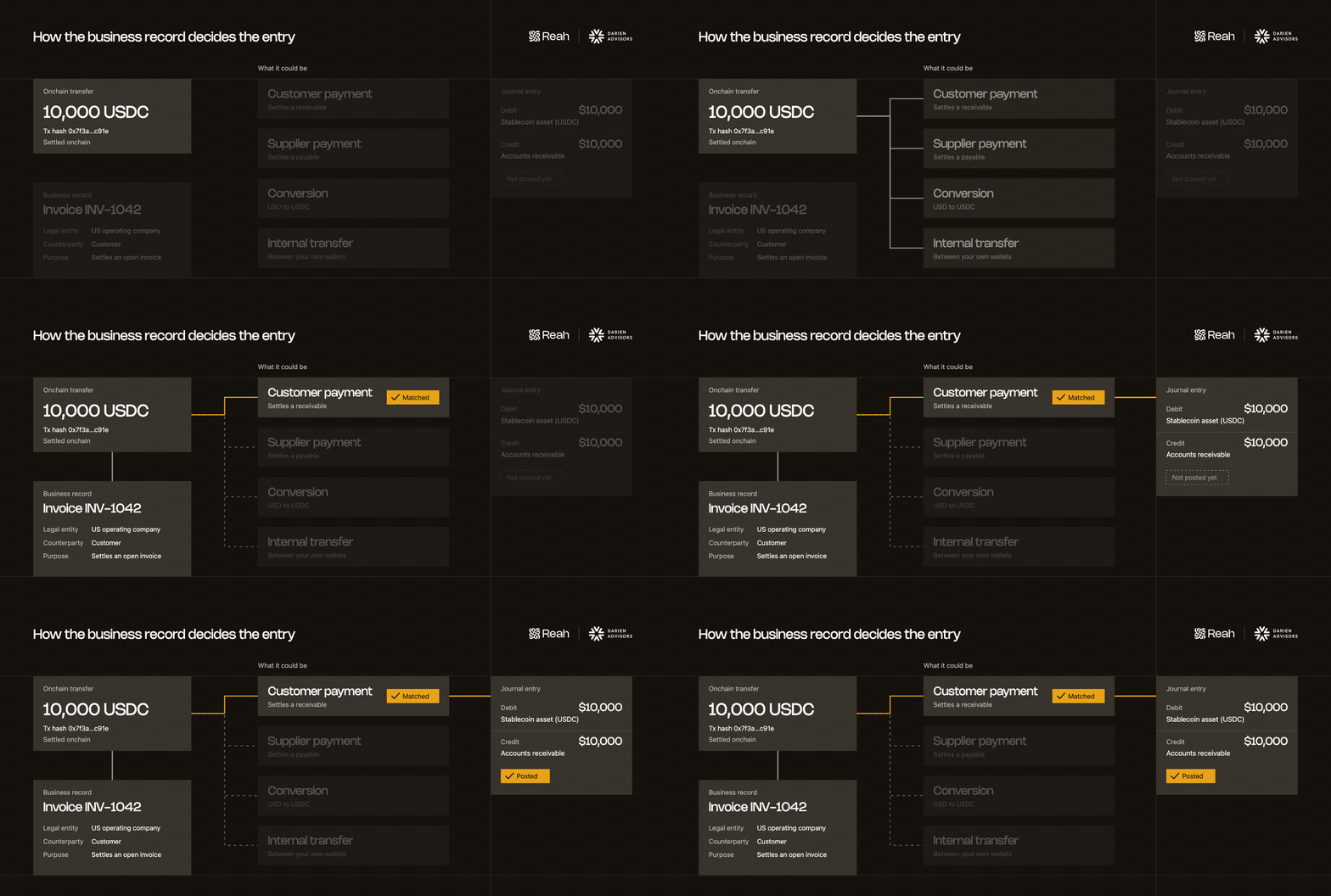
A blockchain transfer establishes that tokens moved between addresses. It does not establish whether the payment settled an invoice, funded another company wallet, discharged an intercompany liability, or purchased an investment. Finance teams must connect the onchain event to the underlying business evidence and apply the accounting framework used by the reporting entity.
This first guide explains how international businesses and foundations can classify stablecoin holdings, document transactions and record common payment, conversion and treasury activity. It starts with the accounting framework applicable to each entity, with US-specific considerations addressed separately where relevant.
Establish classification before building journal entries
Start with the reporting entity and the accounting framework it uses. An offshore foundation, operating company or other international entity may prepare financial statements under IFRS, local GAAP or US GAAP, depending on its jurisdiction, legal requirements, agreements with investors or lenders, and other reporting needs. Incorporation outside the United States does not establish the framework on its own.
Once the framework is identified, assess the rights attached to each stablecoin, including redemption rights and issuer obligations. A token designed to maintain a value of one US dollar is not automatically cash or a cash equivalent. Depending on the asset's contractual terms and the applicable standards, the holder may have a financial asset or may need to apply another accounting model.
Under IFRS, for instance, an enforceable contractual right to receive cash can be relevant to financial-asset classification; tokens without such rights require assessment under other applicable standards. Under US GAAP, the stablecoin's contractual terms and the relevant financial-instrument guidance also matter. FASB's ASC 350-60 requires fair-value measurement through earnings only for crypto intangible assets meeting its specific scope criteria, including conditions concerning enforceable rights to underlying assets. Neither framework supports treating every dollar-pegged token identically.
Document the policy and classification for each asset and holder entity before posting transactions. Revisit those conclusions when token terms, legal rights or reporting circumstances change.
Record the full business event
For every material stablecoin transaction, retain a consistent identifier and supporting record. An accountant should be able to reconstruct the movement, identify the owner and counterparty, establish the commercial purpose, and trace the resulting entry into the general ledger.
Information to capture | Why it matters |
|---|---|
Transaction ID and onchain hash | Connects source events to the ledger entry |
Asset, token contract, network, quantity | Supports token identification and unit balances |
Initiation, execution and settlement times | Supports recognition date and cutoff |
Source/destination account and legal entity | Establishes ownership and which books are affected |
Counterparty, invoice or agreement, business purpose | Determines the nature of the receivable, payable, expense or transfer |
USD amount, valuation time and source | Supports recognition, measurement and later review |
Network fees, conversion charges and other costs | Separates costs from principal movements |
Invoice, approval and settlement documentation | Supports audit trail and review |
Some payment flows generate several blockchain events and one commercial transaction; others involve a single onchain transfer that settles multiple obligations. The accounting transaction identifier should therefore remain distinct from a blockchain transaction hash.
Record customer receipts against the underlying obligation
Customer receipts require attention to the point when revenue was earned and whether an accounts receivable or contract liability already exists. Under an accrual model, a payment received against an existing invoice settles the receivable. It should not create a second revenue entry.
For example, if a business has a recognized $10,000 receivable and accepts 10,000 USDC in settlement, and the applicable initial measurement of the USDC received is $10,000, the simplified entry is:
Account | Debit | Credit |
|---|---|---|
Stablecoin asset — USDC | $10,000 | |
Accounts receivable | $10,000 |
If the payment is received before the performance obligation has been satisfied, the offsetting balance may instead be a contract liability under the applicable revenue-recognition policy. A difference between the receivable balance and the measured consideration received requires an appropriate settlement analysis. The commercial invoice, payment instruction, amount credited, valuation support, and wallet receipt should be linked.
Record conversions as acquisitions and disposals
Buying USDC with dollars generally results in an asset acquisition; redeeming or selling it involves derecognition under the applicable accounting model. These should not be posted mechanically as movements between two equivalent bank cash accounts without a documented classification assessment.
As a simplified illustration, if 10,000 USDC is purchased for $10,000 and initially measured at that amount, the entry may be a $10,000 debit to the USDC asset account and a $10,000 credit to bank cash. On a later conversion back to USD, the business records the proceeds received, derecognizes the relevant carrying amount, and accounts for any difference according to the applicable reporting model.
Keep the conversion confirmation and the bank-side settlement record together. Track disclosed fees and spreads and determine their accounting treatment according to the transaction; a platform's zero-fee conversion feature does not remove the need for classification, measurement or supporting documentation.
Distinguish supplier expense from settlement
For a supplier or contractor payment, recording the service expense and settling the resulting liability can be separate accounting events. Suppose a $5,000 contractor payable has already been recognized and the business later transfers USDC with a carrying value of $5,000 to settle it:
Account | Debit | Credit |
|---|---|---|
Accounts payable | $5,000 | |
Stablecoin asset — USDC | $5,000 |
Differences in settlement value and carrying amount may require another entry. Retain invoice terms, counterparty information, payment confirmation and appropriate contractor documentation. Any employment, withholding or other statutory obligations depend on the arrangement and relevant jurisdiction, rather than whether settlement occurs onchain.
Map transfers to legal ownership
Moving funds between two wallets held by the same legal entity generally changes the location of an asset without creating a new external revenue or expense event. The finance team may need an internal account reclassification and a separate network-fee entry.
Consider an offshore foundation that sends USDC to a separately incorporated development company to fund ongoing software work. Even if the same group controls both entities, the transfer cannot simply be treated as a movement between the foundation's own wallets. The foundation and development company must each document what the payment represents under their agreement, whether that is a service settlement, loan, capital contribution or another arrangement, and record it on the appropriate entity's books. Any consolidation treatment is a separate question. The legal relationship and commercial substance, not the wallet addresses alone, determine the entries.
Identify what treasury tokens represent
A stablecoin transfer into a tokenized Treasury, money-market, or private-credit product may purchase an asset with rights materially different from the stablecoin used to fund it. Examine the instrument or fund documentation to determine what the entity legally holds, how the position is measured, when income is recognized, and how redemption works.
The accounting record should distinguish principal, distributions or interest, required valuation adjustments, redemption proceeds and fees. A quoted yield does not itself determine an income-recognition entry. For example, if an offshore foundation holds a tokenized treasury position, its finance team needs to establish the foundation's ownership rights and retain the relevant product statements and valuation evidence alongside any onchain movements.
Additional considerations for businesses with US exposure
For offshore foundations and businesses, US financial reporting and tax rules are not automatic defaults. However, US owners, employees, services performed in the United States, operations or other US connections can create separate tax, payroll, withholding or information-reporting questions. An entity may also choose or be required by investors or financing agreements to prepare US GAAP financial statements; that accounting decision is distinct from its tax obligations.
Where US federal tax rules apply, digital assets are generally treated as property. Acquisitions, conversions, payments and dispositions may require records of cost basis, proceeds and resulting gain or loss, even for dollar-pegged stablecoins. Transfers between wallets owned by the same taxpayer are generally not taxable dispositions, although transaction fees may need separate treatment. Finance teams should have advisers assess which requirements actually apply to the relevant entity and activity.
Prepare the record for reconciliation
An accounting-ready operation gives reviewers more than a list of wallet transactions. It identifies the legal entity, establishes why each transaction occurred, preserves the valuation and source documentation, and records the asset or obligation affected. Reah's connected banking, wallet, payments and treasury workflows give finance teams a more consistent operational view of activity across fiat and stablecoins. This helps accountants trace movements and locate supporting records, while accounting treatment and journal entries remain their responsibility.
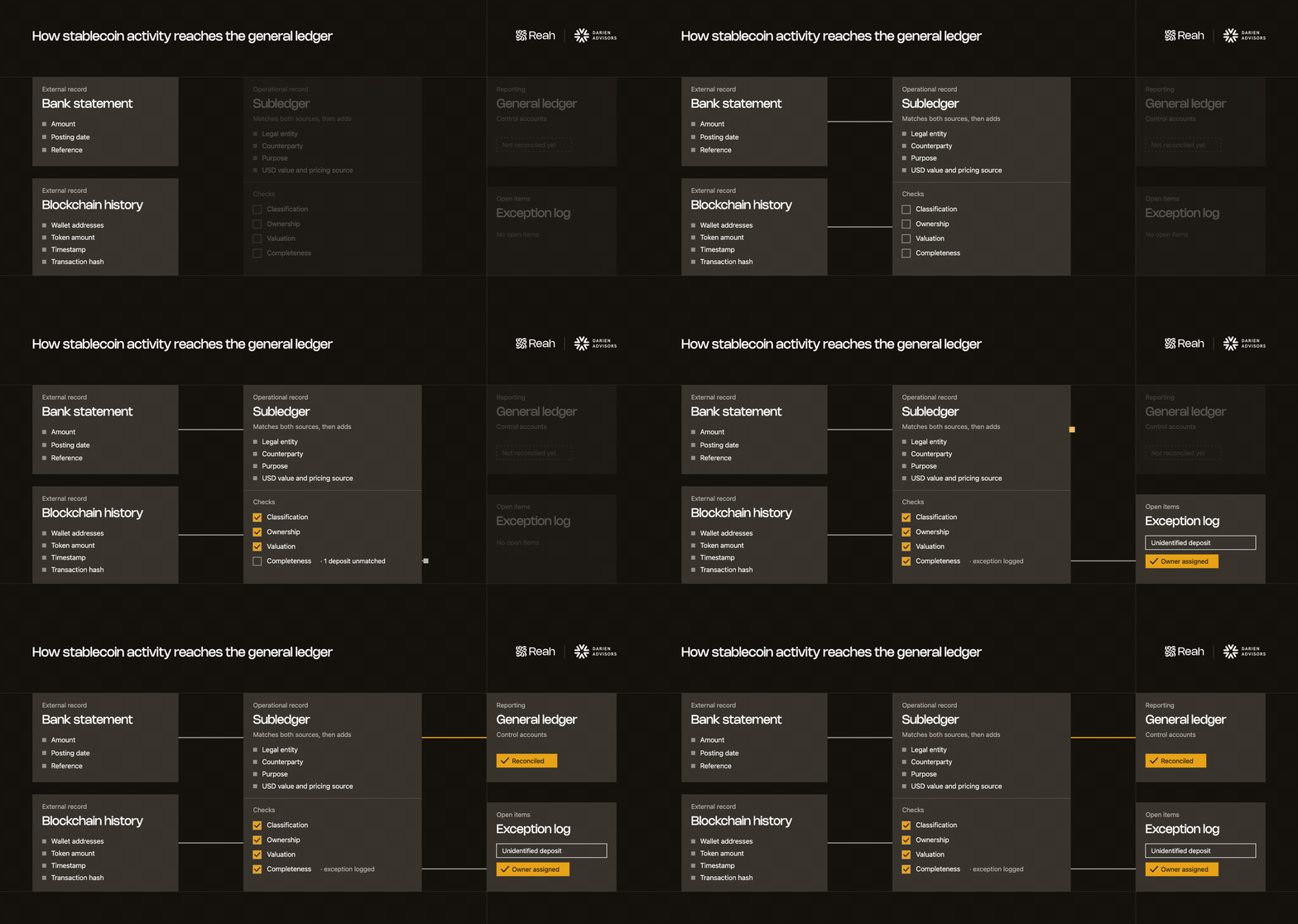
These records provide the starting point for the next stage of accounting: reconciling bank activity, wallet movements and ledger balances, and investigating any differences before the books are closed.
Frequently asked questions
Which accounting framework should an offshore foundation or business follow?
The answer depends on the entity's jurisdiction, legal and regulatory requirements, financing agreements and the financial statements its stakeholders need. It may use IFRS, local GAAP or US GAAP where appropriate. The framework should be established before classifying stablecoin holdings or adopting valuation policies; an offshore incorporation or USD-denominated balance does not by itself determine the answer.
Can an offshore business have US tax or reporting obligations?
Yes, depending on its circumstances. US owners, employees or activities in the United States can raise tax, payroll, withholding or information-reporting questions, but no single connection automatically creates every obligation. The entity's legal structure, tax classification, where services are performed and the nature of its US activity need to be assessed separately from the accounting treatment of its stablecoin transactions.
Does moving stablecoins between company wallets create an accounting entry?
A transfer between two wallets owned by the same legal entity generally changes where an asset is held, rather than creating revenue or a new expense. The business may need an internal account reclassification and a separate entry for network fees. A transfer involving different legal entities requires separate analysis; common group ownership does not make the movement an internal transfer within one entity.
About Reah
Reah is a business finance platform for global businesses operating in fiat and stablecoins. Most international businesses run their money across separate banks, digital asset wallet and card providers, and spreadsheets.
Reah replaces that patchwork with one operational ledger offering multi-currency business accounts, self-custody wallets, international payments, Visa corporate cards, tokenized treasury and operational automation. So borderless businesses can manage their financial activity across both rails in one place.
Learn more at reah.com
About Darien Advisors
Darien Advisors provides tax and accounting for people and companies in the digital economy. Most keep their books, tax filings, and planning with separate providers, each working from different records.
Darien closes that gap with one integrated engagement and a named senior advisor, so the conversation starts before the deadline does. Since 2021 the practice has served more than 1,000 clients, from protocols and funds to founders, families, and investors.
Learn more at darienadvisors.co
This article is for general informational purposes only and does not constitute accounting, tax, legal, or investment advice. Actual treatment depends on the relevant facts, contractual rights, jurisdiction, and applicable rules. Reah and Darien Advisors are independent companies.

Reah is a financial operating system for global businesses.
Fiat banking, stablecoin treasury, cross-border payments, and AI-native execution on one ledger.