
AI adoption across corporate finance has accelerated in recent years, and it’s not hard to see why. Finance sits at the intersection of structured data, strict rules, and high-stakes decisions, making it one of the most compelling enterprise use cases for AI.
Why Finance Is a Natural Fit for AI
Finance has historically been slower to adopt new technologies, and for good reason. Regulatory requirements, audit obligations, and the high cost of errors create a bias toward proven systems over new ones.
The challenge finance teams face isn’t expertise—it’s complexity.
As businesses expand across entities, currencies, and markets, finance becomes increasingly fragmented. Data is spread across ERP systems, banking platforms, spreadsheets, and reporting tools. Each added layer of complexity creates more manual work, more handoffs, and more opportunities for delays.
The cost isn’t always obvious. It shows up in longer close cycles, stale information, and teams spending hours reconciling data and moving information between systems. As complexity grows, so does the cost of maintaining fragmented processes, often requiring additional headcount just to keep up. These tasks demand precision and consistency, but they consume time that could otherwise go to analysis, planning, and strategy.
Financial data is highly structured, workflows are largely repeatable, and the cost of errors is high—exactly the conditions where AI performs best.
How AI Is Changing Finance
AI is already changing how finance teams operate. Invoice processing, reconciliation, and transaction matching are increasingly automated. Processes that once took days can now be completed in a fraction of the time.
Automating individual tasks, however, is only the first step.
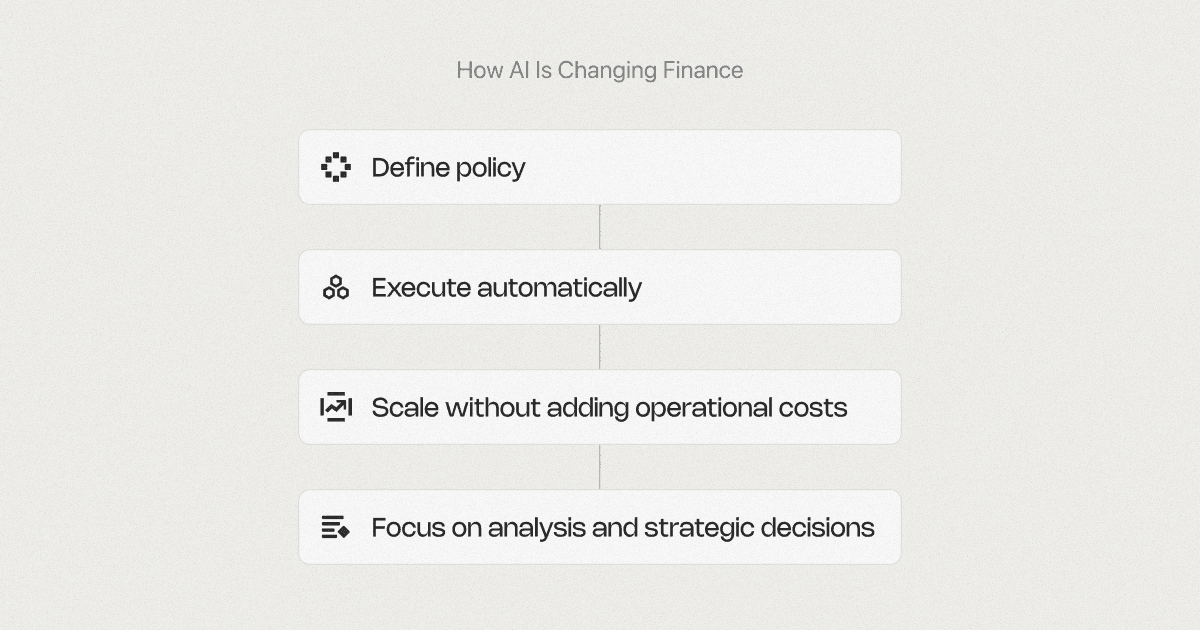
The most powerful systems don’t just automate tasks; they coordinate workflows end to end. They pull data, apply rules, flag exceptions, and route issues for review within predefined guardrails. Finance professionals oversee the process rather than executing every step.
Consider a business operating across multiple entities. A finance manager can simply ask an AI copilot to replenish a subsidiary’s operating account from an approved reserve. The system applies predefined policies, executes the transfer, and automatically records the intercompany movement. Tasks that once took hours of coordination across systems can now be completed in minutes.
Furthermore, because these systems operate continuously, exceptions can be identified in real time instead of being discovered at the end of a reporting cycle. The bottleneck in finance has never been access to data alone—it’s the time and effort required to move from data to decision to action.
What This Means for Finance Teams
AI is not replacing finance teams; it is changing how their time is spent.
As execution becomes more automated, finance professionals can spend less time producing information and more time interpreting it. Execution becomes the baseline.
The real work becomes judgment.
Reah is a financial operating system for global businesses — fiat banking, stablecoin treasury, cross-border payments, and AI-native execution on one ledger. Learn more at reah.com
Share this article


