Global Finance

Treasury Management in the Age of Digital Assets

Reah Team

Summary

When a company receives a payment, that money rarely stays put. It moves between accounts, converts across currencies, is invested in short-term instruments to earn a return, and is held in reserve for upcoming obligations.

Treasury management is the work of keeping cash visible, productive, and in the right place at the right time.

For decades, the underlying processes have remained largely the same. What is changing now is the infrastructure those processes run on.

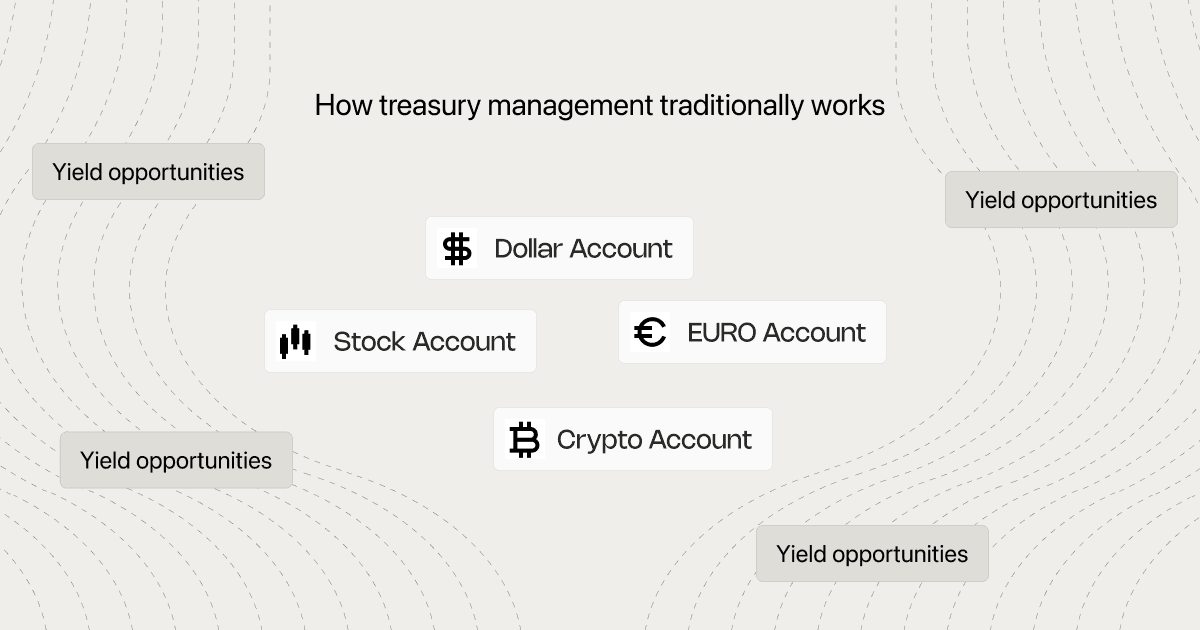
How treasury management traditionally works

At its core, treasury management comes down to three things: visibility, liquidity, and control.

Visibility means knowing how much cash the business has across accounts, currencies, and entities at any moment. Liquidity means ensuring excess cash remains productive by allocating it into short-duration instruments while preserving access when needed. Control means ensuring funds move according to policy, with the audit trail that compliance and accounting teams require.

These objectives have remained remarkably consistent over time. The mechanics work, but they were built for a banking system with fixed operating hours, multi-day settlement windows, and a clear separation between currencies.

Deploying liquidity across jurisdictions often requires additional banking relationships, conversions, and operational overhead. Moving funds between entities in different countries frequently involves multiple intermediaries, each adding cost, complexity, and delay.
What digital assets add to the picture

Digital assets are increasingly being used for payments, settlement, and treasury operations. Among them, stablecoins have emerged as the most practical asset because they are designed to maintain a 1:1 value with fiat currencies such as the US dollar while operating on programmable infrastructure.

For treasury teams, stablecoins introduce capabilities that are difficult to achieve through traditional finance alone, including broader access to global markets enabled by blockchain. Through tokenized real-world assets (RWAs), traditional financial instruments can now move on-chain, giving businesses access to opportunities beyond their domestic financial systems.

Settlement can happen around the clock. A stablecoin transaction can settle within minutes, regardless of the day, time, or location of the counterparty. There are no banking cut-off times, correspondent banking delays, or weekend holds.

Liquidity can be managed more efficiently. On-chain yield products allow treasury teams to allocate and recall capital programmatically, reducing the coordination and settlement friction associated with moving funds between accounts and investment vehicles.

Visibility improves as well. Because balances and transactions exist on a shared ledger, treasury teams can maintain near real-time visibility into positions and flows without waiting for end-of-day reporting cycles.

What this means for treasury teams

The shift isn’t about replacing existing treasury practices. It’s about enabling a more programmable approach to treasury management, supported by on-chain infrastructure.

Capital that once sat idle can increasingly be deployed and recalled based on policy rules rather than manual decisions, allowing businesses to optimize yield more efficiently. Liquidity across entities and currencies becomes easier to coordinate. Funds can move across borders without many of the delays and intermediary costs that have historically made global treasury management operationally complex.

For treasury teams, this represents a shift from reactive to programmable: from manually coordinating between banks, custodians, and investment vehicles, to defining rules that execute automatically against a real-time ledger.
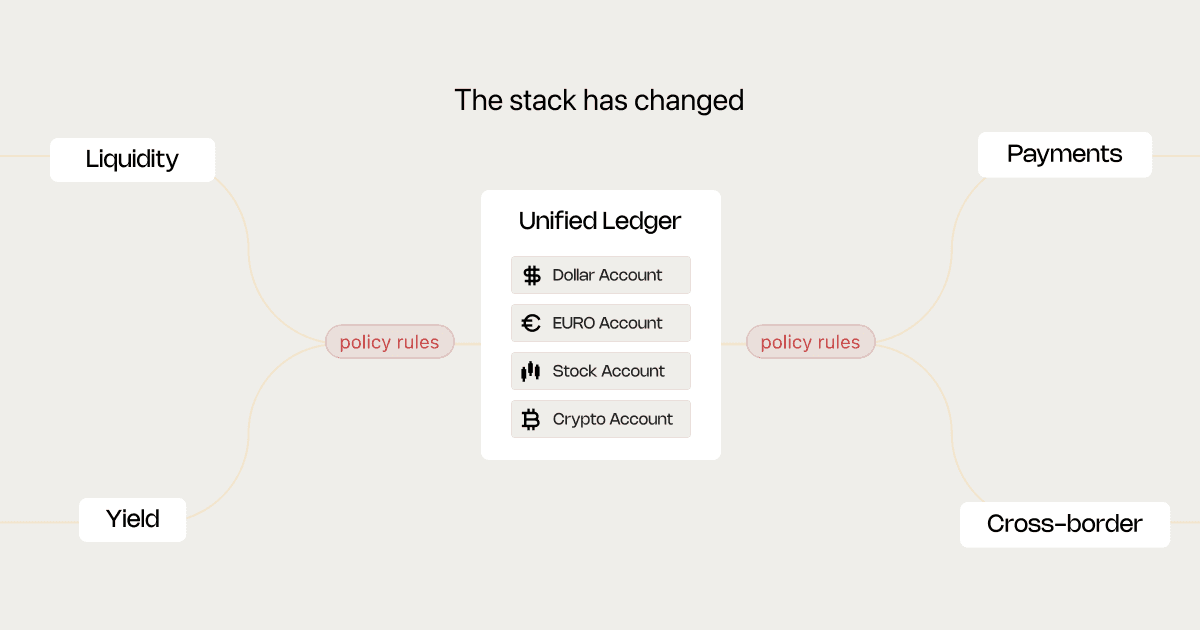
Reah is a financial operating system for global businesses — fiat banking, stablecoin treasury, cross-border payments, and AI-native execution on one ledger. Learn more at reah.com

Try Reah for free

In this article

Title

Share this article

Reah Inc. (“Reah”) is a financial technology company, not a bank, broker-dealer, or investment adviser. The Reah Platform provides software tools that enable you to access services offered by third-party providers. Reah does not provide investment, legal, tax, or financial advice.

Banking services are provided by third party banking partners, not by Reah. Reah itself is not FDIC-insured.

Any yield or return displayed on the Reah Platform is generated through third-party blockchain protocols and is variable, not guaranteed, and not provided by a bank. Past performance is not indicative of future results. You could lose your entire principal.

Digital asset services, including self-custody wallets, swaps, and DeFi protocol access, are provided by third parties or operate on public blockchains. Digital assets are not legal tender, are not backed by a government, and are not FDIC-insured or protected by SIPC. Digital asset transactions are irreversible.

Corporate charge card products are issued by a third-party issuer and are subject to credit approval. 

Reah may receive compensation from third-party service providers.

Use of the Reah Platform is subject to the Terms of Use and Privacy Policy, which include limitations of liability, a class action waiver, and mandatory arbitration.

Reah Inc. (“Reah”) is a financial technology company, not a bank, broker-dealer, or investment adviser. The Reah Platform provides software tools that enable you to access services offered by third-party providers. Reah does not provide investment, legal, tax, or financial advice.

Banking services are provided by third party banking partners, not by Reah. Reah itself is not FDIC-insured.

Any yield or return displayed on the Reah Platform is generated through third-party blockchain protocols and is variable, not guaranteed, and not provided by a bank. Past performance is not indicative of future results. You could lose your entire principal.

Digital asset services, including self-custody wallets, swaps, and DeFi protocol access, are provided by third parties or operate on public blockchains. Digital assets are not legal tender, are not backed by a government, and are not FDIC-insured or protected by SIPC. Digital asset transactions are irreversible.

Corporate charge card products are issued by a third-party issuer and are subject to credit approval. 

Reah may receive compensation from third-party service providers.

Use of the Reah Platform is subject to the Terms of Use and Privacy Policy, which include limitations of liability, a class action waiver, and mandatory arbitration.

Reah Inc. (“Reah”) is a financial technology company, not a bank, broker-dealer, or investment adviser. The Reah Platform provides software tools that enable you to access services offered by third-party providers. Reah does not provide investment, legal, tax, or financial advice.

Banking services are provided by third party banking partners, not by Reah. Reah itself is not FDIC-insured.

Any yield or return displayed on the Reah Platform is generated through third-party blockchain protocols and is variable, not guaranteed, and not provided by a bank. Past performance is not indicative of future results. You could lose your entire principal.

Digital asset services, including self-custody wallets, swaps, and DeFi protocol access, are provided by third parties or operate on public blockchains. Digital assets are not legal tender, are not backed by a government, and are not FDIC-insured or protected by SIPC. Digital asset transactions are irreversible.

Corporate charge card products are issued by a third-party issuer and are subject to credit approval. 

Reah may receive compensation from third-party service providers.

Use of the Reah Platform is subject to the Terms of Use and Privacy Policy, which include limitations of liability, a class action waiver, and mandatory arbitration.

Reah Inc. (“Reah”) is a financial technology company, not a bank, broker-dealer, or investment adviser. The Reah Platform provides software tools that enable you to access services offered by third-party providers. Reah does not provide investment, legal, tax, or financial advice.

Banking services are provided by third party banking partners, not by Reah. Reah itself is not FDIC-insured.

Any yield or return displayed on the Reah Platform is generated through third-party blockchain protocols and is variable, not guaranteed, and not provided by a bank. Past performance is not indicative of future results. You could lose your entire principal.

Digital asset services, including self-custody wallets, swaps, and DeFi protocol access, are provided by third parties or operate on public blockchains. Digital assets are not legal tender, are not backed by a government, and are not FDIC-insured or protected by SIPC. Digital asset transactions are irreversible.

Corporate charge card products are issued by a third-party issuer and are subject to credit approval. 

Reah may receive compensation from third-party service providers.

Use of the Reah Platform is subject to the Terms of Use and Privacy Policy, which include limitations of liability, a class action waiver, and mandatory arbitration.