Global Finance

How Reah and LI.FI Power Conversion Between Fiat and Digital Assets

Reah Team

Businesses increasingly need to move between fiat currencies, stablecoins, and other digital assets as part of their financial operations. Yet doing so still requires navigating banking platforms, exchanges, wallets, and bridges. Reah unifies fiat and digital asset conversion in a single financial operating system. LI.FI powers the onchain orchestration and execution layer that connects assets and liquidity across supported blockchains.

The gap in fiat-first infrastructure

Fiat-first platforms are built around bank accounts, cards, and conventional payment rails. They typically stop at the point where funds need to move into onchain markets.

A business starting from fiat may need one provider to convert its funds into a stablecoin, another to swap that stablecoin into the required asset, and a bridge to reach the destination network. The reverse journey can be equally fragmented. Each provider supports different assets, networks, and liquidity sources.

The challenge is not simply gaining access to digital assets. It is connecting fiat and onchain conversion without requiring businesses to assemble and manage the underlying route themselves.

How LI.FI powers Reah’s onchain conversion

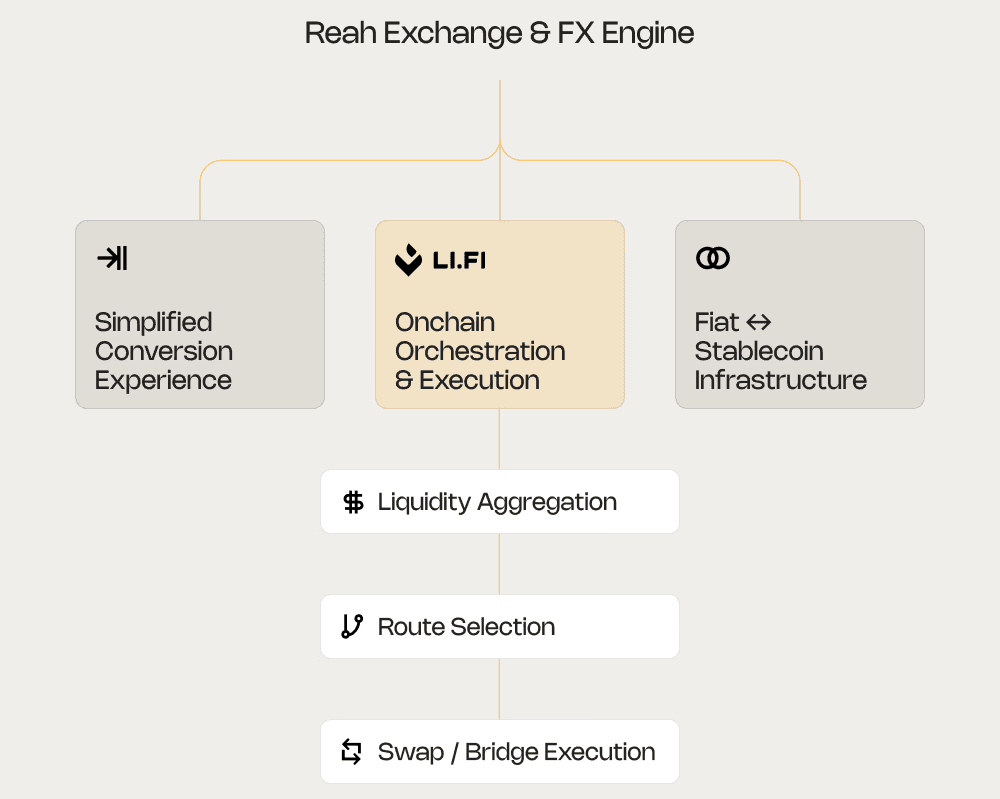
Reah’s Exchange & FX Engine gives businesses one place to initiate conversions across supported fiat currencies and digital assets. For the onchain component, Reah integrates LI.FI’s liquidity aggregation, routing, and execution infrastructure. When a conversion requires an onchain swap, LI.FI queries its integrated liquidity sources and identifies an available route for the requested asset and network pair. Depending on the route, execution may involve a same-chain swap or a combination of swapping and bridging across networks.

Reah presents this capability within the wider conversion experience. Businesses can initiate the transaction through Reah while LI.FI handles the underlying onchain path.
What an on/off-ramp conversion looks like in Reah

Consider a business that holds USD and needs USDC on a supported network. A simplified on-ramp conversion could work as follows:

  1. The business selects its USD balance and USDC as the target asset in Reah.

  2. Reah converts the USD into USDC through its fiat-to-stablecoin infrastructure.

  3. The resulting USDC arrives in the business’s finance-grade Reah wallet on the selected network.

For an off-ramp, the business may start with USDC or another supported digital asset. If the source asset must first be converted into a supported stablecoin, LI.FI routes and executes that onchain conversion. Reah then converts the stablecoin into the selected payout currency and sends the funds through an available local bank rail.

Reah currently supports payouts in USD, EUR, GBP, SGD, AED, and HKD. Available payout currencies and rails vary by business location, account setup, and recipient destination. When an onchain conversion is required, the exact path depends on the selected asset, network, and available liquidity.

One integration across fragmented onchain liquidity

Reah currently supports more than 100 active businesses. As they operate across more currencies, assets, and networks, Reah needs a scalable way to support onchain conversion without maintaining a separate integration with every exchange, liquidity source, or bridge. LI.FI supports swaps and bridges across more than 60 chains. Through one integration, Reah can access LI.FI’s aggregated onchain liquidity and orchestration infrastructure while remaining focused on the financial experience its business users interact with.

What this means for finance teams

For finance teams, conversion is rarely the end goal. It is a means to acquire an asset, position liquidity on the right network, or return onchain funds to a fiat balance. They should not have to assemble a route across separate exchanges and bridges to achieve it.

With LI.FI’s onchain orchestration system integrated into Reah’s financial operating system, businesses can move between supported fiat and onchain assets through a single conversion experience, without managing the underlying liquidity venues or onchain routes themselves.

About Reah

Reah is a financial operating system for global businesses, unifying fiat banking, stablecoin treasury, cross-border payments, and AI-native execution in one ledger. Reah enables finance teams to manage money across traditional and digital asset rails with built-in controls, approvals, and auditability across every workflow.

About LI.FI

LI.FI is the universal liquidity layer trusted by more than 1,000 enterprises to unlock unified market access to digital assets. LI.FI reduces the complexity of building digital asset products by orchestrating liquidity across permissioned and permissionless venues, powering stablecoin and RWA flows across more than 60 chains through a single integration.

In this article

Title

Share this article

Reah Inc. (“Reah”) is a financial technology company, not a bank, broker-dealer, or investment adviser. The Reah Platform provides software tools that enable you to access services offered by third-party providers. Reah does not provide investment, legal, tax, or financial advice.

Banking services are provided by third party banking partners, not by Reah. Reah itself is not FDIC-insured.

Any yield or return displayed on the Reah Platform is generated through third-party blockchain protocols and is variable, not guaranteed, and not provided by a bank. Past performance is not indicative of future results. You could lose your entire principal.

Digital asset services, including self-custody wallets, swaps, and DeFi protocol access, are provided by third parties or operate on public blockchains. Digital assets are not legal tender, are not backed by a government, and are not FDIC-insured or protected by SIPC. Digital asset transactions are irreversible.

Corporate charge card products are issued by a third-party issuer and are subject to credit approval. 

Reah may receive compensation from third-party service providers.

Use of the Reah Platform is subject to the Terms of Use and Privacy Policy, which include limitations of liability, a class action waiver, and mandatory arbitration.

Reah Inc. (“Reah”) is a financial technology company, not a bank, broker-dealer, or investment adviser. The Reah Platform provides software tools that enable you to access services offered by third-party providers. Reah does not provide investment, legal, tax, or financial advice.

Banking services are provided by third party banking partners, not by Reah. Reah itself is not FDIC-insured.

Any yield or return displayed on the Reah Platform is generated through third-party blockchain protocols and is variable, not guaranteed, and not provided by a bank. Past performance is not indicative of future results. You could lose your entire principal.

Digital asset services, including self-custody wallets, swaps, and DeFi protocol access, are provided by third parties or operate on public blockchains. Digital assets are not legal tender, are not backed by a government, and are not FDIC-insured or protected by SIPC. Digital asset transactions are irreversible.

Corporate charge card products are issued by a third-party issuer and are subject to credit approval. 

Reah may receive compensation from third-party service providers.

Use of the Reah Platform is subject to the Terms of Use and Privacy Policy, which include limitations of liability, a class action waiver, and mandatory arbitration.

Reah Inc. (“Reah”) is a financial technology company, not a bank, broker-dealer, or investment adviser. The Reah Platform provides software tools that enable you to access services offered by third-party providers. Reah does not provide investment, legal, tax, or financial advice.

Banking services are provided by third party banking partners, not by Reah. Reah itself is not FDIC-insured.

Any yield or return displayed on the Reah Platform is generated through third-party blockchain protocols and is variable, not guaranteed, and not provided by a bank. Past performance is not indicative of future results. You could lose your entire principal.

Digital asset services, including self-custody wallets, swaps, and DeFi protocol access, are provided by third parties or operate on public blockchains. Digital assets are not legal tender, are not backed by a government, and are not FDIC-insured or protected by SIPC. Digital asset transactions are irreversible.

Corporate charge card products are issued by a third-party issuer and are subject to credit approval. 

Reah may receive compensation from third-party service providers.

Use of the Reah Platform is subject to the Terms of Use and Privacy Policy, which include limitations of liability, a class action waiver, and mandatory arbitration.

Reah Inc. (“Reah”) is a financial technology company, not a bank, broker-dealer, or investment adviser. The Reah Platform provides software tools that enable you to access services offered by third-party providers. Reah does not provide investment, legal, tax, or financial advice.

Banking services are provided by third party banking partners, not by Reah. Reah itself is not FDIC-insured.

Any yield or return displayed on the Reah Platform is generated through third-party blockchain protocols and is variable, not guaranteed, and not provided by a bank. Past performance is not indicative of future results. You could lose your entire principal.

Digital asset services, including self-custody wallets, swaps, and DeFi protocol access, are provided by third parties or operate on public blockchains. Digital assets are not legal tender, are not backed by a government, and are not FDIC-insured or protected by SIPC. Digital asset transactions are irreversible.

Corporate charge card products are issued by a third-party issuer and are subject to credit approval. 

Reah may receive compensation from third-party service providers.

Use of the Reah Platform is subject to the Terms of Use and Privacy Policy, which include limitations of liability, a class action waiver, and mandatory arbitration.